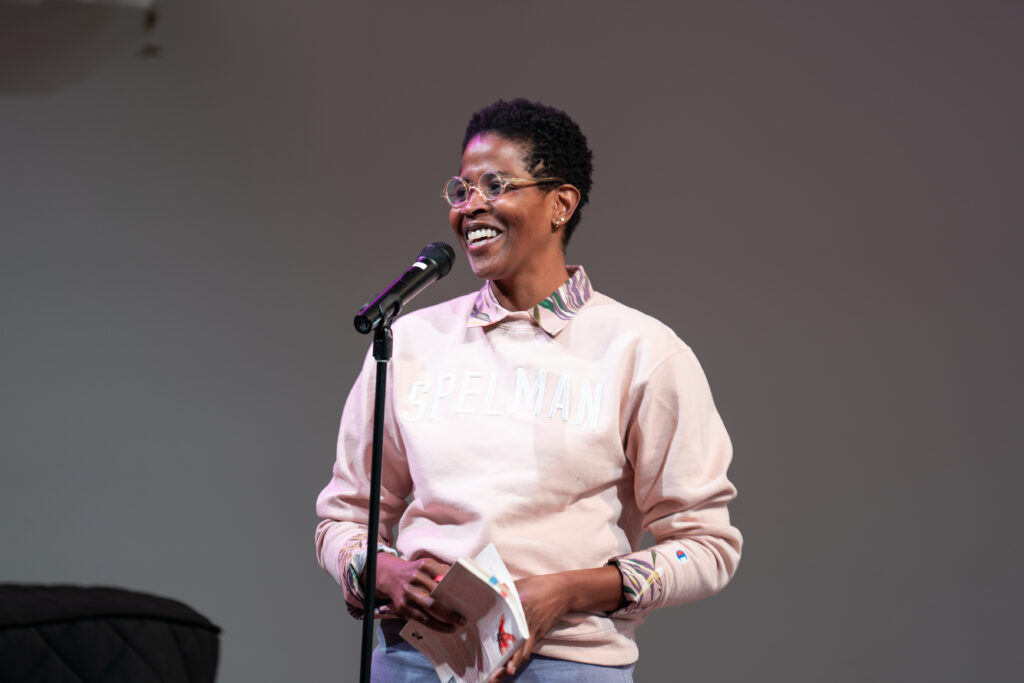
Arisa White is the author of two poetry chapbooks and the recipient of multiple awards and honors. Her first full-length collection Hurrah’s Nest, nominated for the 44th NAACP Image Award, made some of Gertrude’s editorial staff fall in love and want to know more. Her second full-length collection, A Penny Saved, was published by Willow Books. Gertrude’s Elizabeth Simson had the honor of interviewing Arisa for issue 19 of Gertrude. We hope you enjoy what we discovered.
Elizabeth Simson (ES): This is your first collection. How long have you been writing? Talk a little about the journey to creating this book. Poets sometimes ask us about the process of gathering poems for a manuscript. How did you select and order the poems for Hurrah’s Nest?
Arisa White (AW): I’ve been writing for over a decade. “Follow” was written as an undergrad at Sarah Lawrence. I was in a workshop with Thomas Lux. (I enjoyed staring at the slouch socks he wore with his tapered jeans.) After class, Thomas came up to me and said that if I ever needed anything—needed to talk—he was there for me. He thought it was me in the poem. He told me to get out of it. I was upset he thought it was me and equally moved by his caring. As I pulled together the poems of this collection, I had to honor the fact that these were true stories. I couldn’t escape them or separate myself from them.
I continued to write poems, without thinking about them as part of a collection, while taking Cave Canem workshops in Manhattan and in graduate school at UMass Amherst. A variation of Hurrah’s Nest was my thesis project. I sent the manuscript off to contests and publishers after grad school and received rejections. I reflected on what was working, what wasn’t. I got feedback from editor friends and asked non-poetry people to read it to see if it appealed to them, if they had questions about clarity, narrative arc, etc. Using all that feedback over these past four years, I deliberately put all my family poems together, narrowed it down to a time period, chronologically ordered them, and soon I could see what was missing, what wasn’t said.
“Disposition for Shininess” is one of those poems added to give it volume, to give my voice the rage and confusion it needed to create a fully complex emotional experience for the reader. “You smellin ya’self gal?” is the last piece I wrote for Hurrah’s Nest. (I was at Hedgebrook in 2010 and it came to me—I think subconsciously I wanted the challenge of writing lyrical prose—and I enjoyed writing it; I could hear my brothers’ voices so clearly. I laughed so much while writing it.) I needed the prose form to ground the collection, as well as be a narrative fulcrum to which all the other poems could refer.
In thinking about how to open and close the book, it made sense for me to begin it with a poem that uses my siblings’ names. The opening poem is somewhat an epistle to my youngest brother, chronicling the experiences he was not a part of. Then the closing poem addresses another brother, who is older, proposing the need to revisit and unearth the stories and beliefs that have shaped us, so that we are not limited by those stories and beliefs.
When Virtual Artists Collective accepted the book in 2011 for publication, I asked my siblings for permission to use their names. I sent them the manuscript and hoped that they approved of what I wrote. It was so great they said yes, quite immediately after I sent them emails. As I look back, it makes sense that this is my first collection—in some ways it is a tribute to the art making that my siblings and I would do when we were little. We created together, and I still keep them close when I create.
ES: There’s a commitment to truth and complexity in your poems, no simple heroes or villains. How does the form/structure/container of poetry support or challenge this complexity?
AW: I often think of poetry as a small private room. Maybe like a good size walk-in closet. And when I invite moments, experiences, and those people who were involved in the experience or moment into that private room, there is intimacy, there is vulnerability, and we will undeniably be human with each other. Our shadow and our light will come. Our good and our bad. Our shame and our triumphs. We will be sensate witnesses to and for each other. Mirrors and shields. And soon the language of right or wrong won’t make much sense. You are forced to live honestly or find a way to get out. And when you find the appropriate container for the poem, be it free verse or the various poetic forms, that containment requires a shedding (of your bullshit) and letting go (of judgments about self and other) to reach the thing that brought you to write the poem in the first place.
ES: You strongly inhabit your voice as oldest daughter in these poems about mothering and childhood. How does your identity of oldest daughter influence the way you approach writing?
AW: I haven’t consciously thought about my identity as oldest daughter factoring into my approach to writing, but what I have learned and understood as the oldest daughter is that everyone else comes before. A kind of personal neglect occurs. I’m more concerned about others; I often overlook my feelings and needs. So I must be careful about how I may obscure the truth from myself. A close of friend of mind, R. Erica Doyle, once said to me, years ago, that I need to write how I feel. No fancy metaphors, just say it plain. That was strange to me; it didn’t seem like poetry to write how I feel. That was a necessary breakthrough because I recognized I was still in my role as oldest daughter, nurturer, woman. Being so selfless, I had no self. I was a whispering voice. I was performing, instead of being. So writing now is more a discovery of something true, something forgotten, something lost along the way. I write now to nurture what is found into being.
ES: The book is dedicated to your siblings: Jamar, Ibert, Kayana, Shaquana, Nigel, and Uriah. Some of the poems (like “Sister”) seem to be a tribute to them. What do you hope to give your family through your poems?
AW: Release. You know, sometimes you have those hard cries, where snot is running and tears are fat and stormy, and you allow yourself to be in it without judgment, shame, or embarrassment. There, in it to the max. Then you’re done; a quiet resolution takes over you and you are free—free—from that thing you’ve been holding on to for so very long.
ES: Do you have any advice for poets on writing about personal experiences in childhood?
AW: Write about it until you can’t write about it anymore. We see ourselves more clearly when we write about and from those childhood experiences.
ES: In your final poem in the book you talk about “uncovering to the grain.” While many of the poems in Hurrah’s Nest are painful, there is also a strong undercurrent of purpose in navigating pain in order to speak truth, confront complicity, and move forward in healing. What helps you to “uncover the grain” within your writing?
AW: Having people and, therefore, experiences that challenge me to look more closely, from another angle or perspective, so that I don’t get caught up on this one idea of myself or come to believe there is one way to be or do things. I don’t allow myself to get stuck or complacent—even though it is sometimes easier to go with the status quo, stay quiet, keep my head down. In ways that are healthy and safe for me, I take risks; I follow my dreams; I consider fear but don’t let it be the reason I do or don’t do something. And this enters my writing, this way of being in the world.
ES: In the midst of difficult stories, the poems “My Little Chuleta” and “It’s Not that My Brother Was Acting a Fool” provide the reader with moments of respite. Longer narrative poems, such as “Disposition for Shininess” and “The Small Places I Go,” are punctuated with punch-to-the-gut phrases: “I’ve learned to trust her like a hive” and “It’s winter when it comes to my words.” Can you talk a little about the process of crafting poetry that both carries powerful impact and leaves breathing space?
AW: It is so very intuitive for me. Most of the time, I am taking an emotion, this wordless thing, and putting language to it. I follow the ebb and flow of that emotion, its peaks and valleys, the way it shapes itself in the gut or chest. And because there is movement in emotions, there are places of breath, where it begins and ends. I try to get that down on my first draft, which I always write by longhand. Noticing the natural intelligence of the poem—prosody, line and stanza breaks, the evolvement of a metaphor, etc.—I then craft the poem around these elements. I whittle away, I add, until the poem has fully articulated its emotional life on the page.
What I wanted to capture in “I’ve learned to trust her like a hive” was the wariness, the desire and fear, of approaching something you know is full of sweet and goodness—there are stings, and possibly death if you’re allergic, that come with getting the honey. I try to find phrases and images that are emotionally complex with many layers. You must explore those layers within yourself to really access the full meaning. There is a way in which my poetry needs the reader to go within herself, to be an emotional being, in order to know what is being said. You can’t be afraid to deeply feel—in those most uncomfortable and complicated ways.
ES: What responsibilities do you carry in writing poems, in sharing them with the world?
The Interview continued here.


